Many SME suppliers treat card acceptance as a cost to be minimized. The fee is visible. The upside is not. That calculation changes when a business buyer wants to finance an invoice in installments and the lender pays the supplier directly with a virtual card. The supplier is paid in full right away on network rails. The buyer repays over time. Acceptance stops being a cost to absorb and starts working as a revenue lever.
Why do suppliers treat card acceptance as a cost?
Suppliers weigh the acceptance fee against benefits they cannot always see. Among suppliers that do not accept cards, 35% say securely storing card information is too difficult and 31% say integrating cards into current systems would be too complex, according to Mastercard research with The Harris Poll. The hesitation has a real price. Two-thirds of suppliers report they fall short of buyer payment expectations, and one in three say they receive late payments because they do not offer a buyer’s preferred method. Viewed only as a fee, card acceptance looks like a drag on margin. Viewed as a way to get paid faster and win more orders, the math looks different.
How does paying a financed invoice with a virtual card work?
The lender disburses the loan straight to the supplier as a card payment. When a business buyer chooses to finance an invoice in installments, the lender approves the amount and issues a single-use virtual card to settle it. A virtual card is a card number generated for one transaction, with controls on amount, merchant and timing. The supplier accepts it the way it accepts any card and receives the full invoice value immediately on network rails. The buyer repays the lender on the agreed schedule. Demand for this path is rising. 48% of B2B suppliers expect buyers to ask to pay by card more often over the next five years, according to Mastercard.
Why disburse to the supplier instead of funding the buyer?
Paying the supplier directly removes a slow and risky step. The traditional financing flow sends the loan into the buyer’s bank account, then waits for the buyer to pay the supplier by ACH. The funds sit with the buyer in between, settlement can take days and reconciliation depends on the buyer acting. Virtual card disbursement skips that hop. The lender pays the supplier directly, the money never rests in the buyer’s account and settlement happens on card rails in the usual card timeframe. The working capital effect is measurable. Mastercard found that suppliers who accept cards are 14 percentage points more likely than non-acceptors to say they are efficient at maximizing working capital.
| Step | Fund the buyer, then ACH | Disburse to supplier by virtual card |
|---|---|---|
| Where the loan lands first | Buyer’s bank account | Supplier, directly |
| Supplier settlement speed | Days, after the buyer initiates ACH | Immediate, on network rails |
| Dependency to get paid | Buyer must act to pay the supplier | None, the lender pays the supplier |
| Funds held in between | Yes, with the buyer | No |
| Reconciliation | Manual matching across two transfers | Single card transaction with set controls |
How does this turn acceptance into a revenue lever?
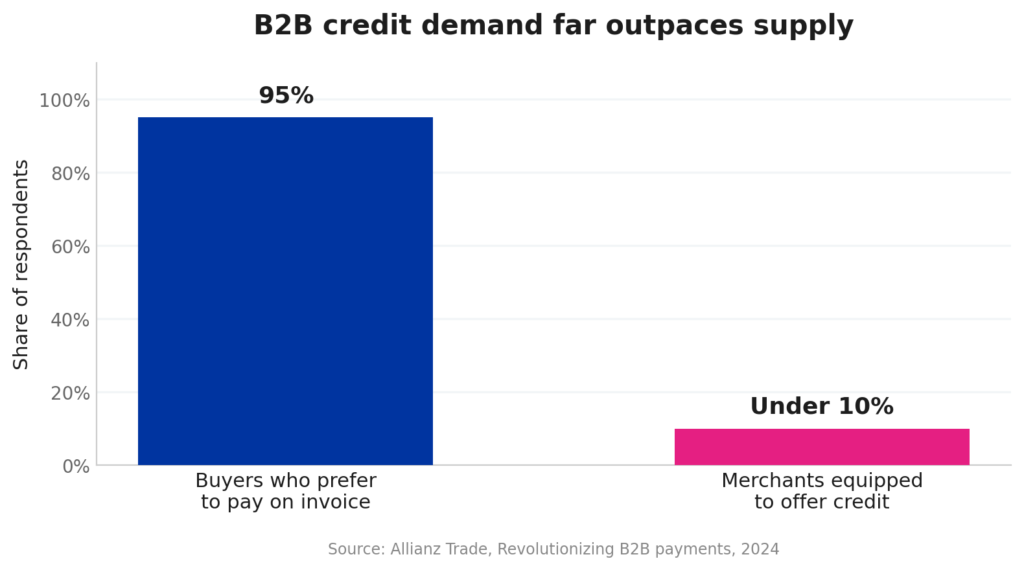
Offering financing at the point of purchase lifts both conversion and order size. Merchants that offer pay-over-time options have reported up to a 40% increase in conversion rates. The unmet demand is large. Allianz Trade reports that 95% of B2B buyers prefer to pay on invoice, yet fewer than 10% of merchants are equipped to offer credit, and 29% of buyers abandon a purchase when flexible payment is missing. A supplier that accepts a card-disbursed loan captures that demand and gets paid in full up front. The acceptance fee is set against larger orders and immediate cash, not against nothing. That is the difference between a cost and a lever.
What should banks and lenders do about it
Offer installment financing that disburses to suppliers by virtual card. Doing so puts the lender at the center of a flow that benefits every party. Card acceptance and lending have been treated as separate decisions. Invoice financing disbursed by virtual card joins them. The supplier gets paid faster on rails it already accepts and trusts, with no new integration. The buyer gets flexible terms at the moment of purchase. The lender turns a payment into a funded loan and a lasting relationship. For banks and lenders deciding where to compete in B2B payments, that is acceptance working as revenue.
Jifiti’s white-labeled virtual card issues at the moment of approval and supports consumer and commercial loans on one platform, so a bank can deliver embedded lending to business buyers in its own brand. Positioned this way, acceptance becomes a shared growth channel rather than a fee suppliers try to avoid.